





Eye For Film >> Movies >> The Peril At Pincer Point (2025) Film Review



Generally when one encounters a low budget production from an inexperienced writer/director team, one finds that technical elements are at best average, and often barely sufficient to enable the suspension of disbelief, whilst the narrative or theme takes centre stage. With The Peril at Pincer Point, it’s the other way around.
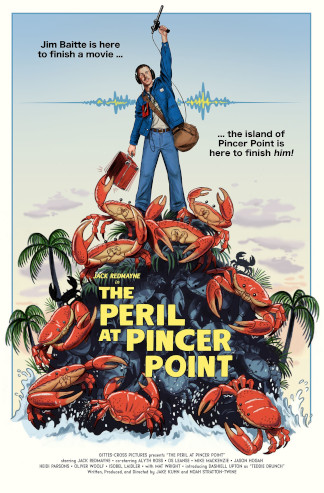
Screened at this year’s SXSW and, more recently, at the Fantasia International Film Festival, the film, which is also a Frightfest pick, takes as its subject the filmmaking process itself. It involves the production of a 1950s-style grand romance between a human woman and a giant crab. Charged with creating the soundscape for this is technician Jim Baitte (Jack Redmayne), but his work doesn’t satisfy a pushy director who wants something completely new and original, so he is dispatched to the remote, mysterious island of Pincer Point to make some recordings at source. Curiously, he has already been injured by a crab which somehow managed to invade his 30th floor London flat. This, and the fact that the wound is resistant to healing, is the first of many worrying omens in what, for all its silliness, is essentially a Gothic tale.
Once Jim reaches his destination, he seeks out local pub The Fat Plankton to ask the surly sailors drinking there where he can find Marina, a local woman reported to have an exceptional singing voice. She, however, has disappeared, and nobody really expects her to return. The general belief is that she has fallen victim to a spectral captain who haunts the shore by night, taking the souls of the young for his ghostly crew. There is talk of people being marked. One would think that this might worry our hero, but focused as he is on the sounds people make, he pays little attention to the meaning of their words. The dialogue is largely improvised and somewhat hit and miss, but there are some great exchanges in which he chats enthusiastically whilst totally failing to take in warnings.
By the time that crabs themselves start talking to Jim, it’s already clear that he’s doomed. The fun – and the horror – lies in watching him get there. This is horror of an old fashioned type, creepy and unsettling rather than bloody or hateful, and unless you’re a kabourophobe or under five then it’s unlikely that you’ll actually find yourself scared. The comedy is another hit and miss affair, and the film is sometimes overly reliant on it, but all of this is really just about getting viewers from the start to the end so they can take in the rest.
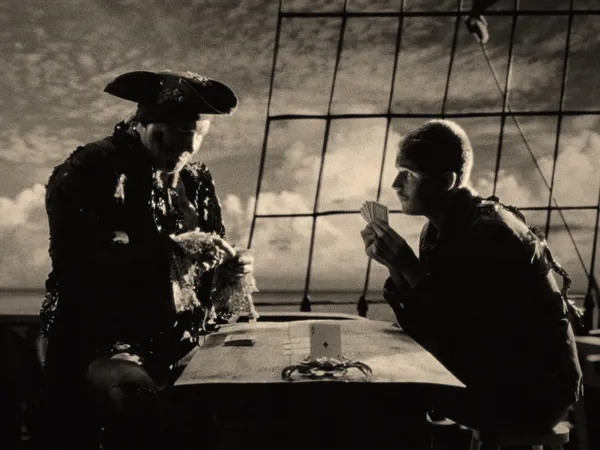
In both the film itself and the film within it, the credit sequences are gorgeous, an early hint of the kind of treats in store. The bulk of the film is shot in luminous shades of grey and white, capturing that magical look that celluloid acquires through natural ageing. There are some beautiful, almost seamless painted backdrops, used in a manner which might remind viewers of the work of Jack Cardiff. And then there’s Joseph Field Eccles and Nick Smyth’s sound design, which is magnificent from start to finish, and full of playful touches. That all this was achieved on a tiny budget with just an 11 day shoot is remarkable.
This is a peculiar little picture whose daring and eccentricity don’t always work in its favour, but from a technical perspective, it’s one of the most impressive works of the year.
Reviewed on: 05 Aug 2026


Director: Jake Kuhn, Noah Stratton-Twine
Writer: Jake Kuhn, Noah Stratton-Twine
Starring: Jack Redmayne, Alyth Ross, Os Leanse, Mike Mackenzie, Dashiell Upton, Jason Hogan, Mat Wright, Noah Stratton-Twine, Isobel Laidler, Oliver Woolf
Year: 2025
Runtime: 83 minutes
Country: UK
Search database:
